

CHAPTER 9.
Coming out together:
Squatting the first ever Gay Community Centre in the UK
Squatting & the Theft
of Private Property
"It is harder to disintegrate a prejudice than an atom"
- Albert Einstein


By I974 squatters’ groups had become well established in and around Brixton. In keeping with radical community politics of the time buildings were squatted to house the homeless but would also serve some community purpose such as free advice and information centres, children's creches, food co-operatives, alternative news services, cafes, bookshops, squatters and claimants' union groups, gig venues and so on. It was at the women's centre at 207 Railton Road that Gary de Vere, Colm Clifford and Alastair Kerr got involved with the squatters' group and continued their friendship with Mary Evans Young and Derek Evans who were both involved in housing activism.
With the exception of a few left labour councillors squatters were often reviled with questions raised in the council chamber about how many council properties had been occupied by ‘unauthorised tenants’. To prevent ‘illegal’ occupation the council sent workmen into empty buildings to make them permanently uninhabitable. Ripping out internal plumbing, pouring concrete into toilet bowls and finally boarding the buildings up were some of the methods used to prevent occupation at a time when the housing crisis had over 20,000 people on Lambeth Council's waiting list for decent accommodation. Initially the council was not averse to vigorously pursuing eviction proceedings through the courts with the inevitable consequences of police and bailiff action in throwing out the occupants and the nailing up of empty properties. Later the position softened a little through pressure from squatters’ groups and the actions of sympathetic Left Labour councillors. With the election in 1978 of Ted Knight as leader of Lambeth Council, a gay revolutionary socialist, a much more sympathetic attitude was adopted towards the squatters' movement.

South London Gay Community Centre, 78 Railton Road, Brixton. 1974-1976
Squatters’ periodically occupied council meetings at Lambeth Town Hall and forced the question of homelessness and empty properties onto the agenda. The offer of short-life property and licenses was taken up by some squatters but the more wary viewed this with suspicion and felt that the homeless were falling into the trap of gaining a partial victory. This would carry the risk of being housed in insecure accommodation and at the mercy of a council agreement which would allow eviction whenever the building was needed. Other squatters took the eventual longer-term route of applying to join various housing co-operatives to secure a home through conversion to housing association properties.
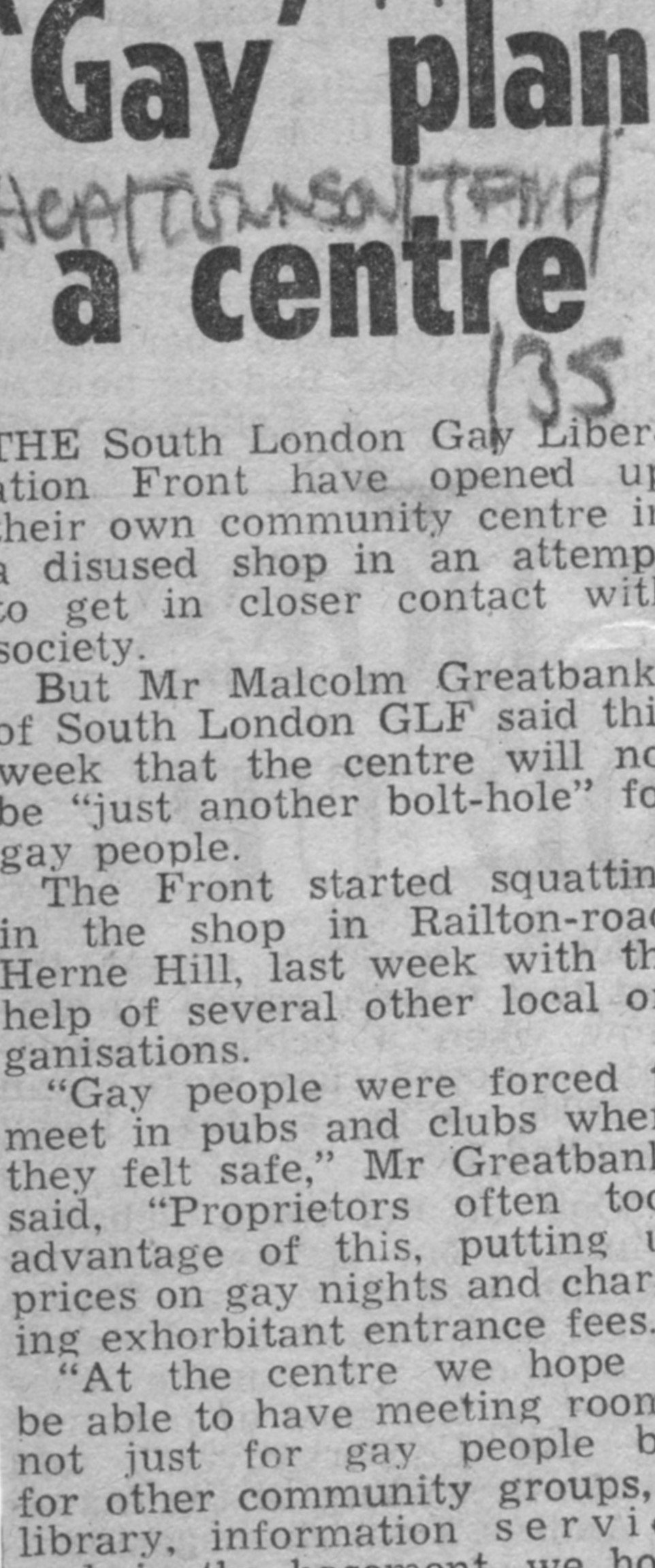
The squatting of the first ever gay community centre in Britain at 78 Railton Road on the Friday evening of 22 March 1974 was something of an anti-climax. Railton Road had been chosen because of the many well-established squats in the area including The Women's Place which was next door at number 80. Other squats and radical/revolutionary organisations had been established including The People's News Service, Icebreakers gay counselling Collective, a black women's centre, Race Today Black Revolutionary group (nearby Shakespeare Road), Brixton Advice Centre, Brixton Housing Co-operative and many communal and individual households. Railton Road also housed several shebeens as alternative social centres partly through racist landlords and managers banning black people from white-owned public houses and clubs.
The initial act of squatting always brought the possibility of falling foul of patrolling police cars and the threat of arrest for criminal damage or breaking and entering but none of this happened in squatting the gay centre. The expectation that Inquisitive neighbours might call the forces of law and order came to nothing as people were either bemused, amused or indifferent to the goings on. Some passers-by even stopped to offer encouragement.
Gary de Vere, Mary Evans Young, Derek Evans and Colm Clifford broke in, changed the locks and took possession of the building with relative ease but not without prior objections from some Gay Liberationists. In a meeting at the Hamilton Arms, to Gary and Colm's annoyance and frustration and noted by Bill Thornycroft, the more conservative elements in SLGLF saw squatting and the unauthorised occupation of premises as an unconscionable theft of private property. There were even objections to having a gay centre at all as a step too far that would provoke hostile reactions. However, despite these objections, having been pushed from pillar to post by hostile publicans and members of the public the SLGLF needed a permanent, secure place and there was a determination by the more activist members to go ahead with the plan.
In order to claim occupancy of the premises and ‘squatters rights’ Bob Kindred, who lived in a squatted basement flat opposite the proposed gay centre and was centrally involved in the local squatters' movement, deposited his plumbing equipment there as proof that the building was being used as a bona fide 'business'. Apart from being a handy man with a van for transporting and storing gay centre furniture he fixed up some floor boards, wiring and so on and gay people moved in a week or so later to carry on clearing up, fitting out the plumbing, building a coffee bar, installing a telephone and decorating the building. Priority areas on how to use the centre and future activities had been decided at a planning session at the Hamilton Arms and Malcolm Greatbank’s flat. In Malcolm’s own words:
"I was living in Talma Road by this time and had been for some time and it so happened that my flat was nearest to the chosen place for the gay centre. Discussions had been going on for quite some time about squatting a gay centre and some people in SLGLF were also involved in the local squatters group. They had a stake in whatever resources the squatters group had in return for the assistance that we gave to squatters generally. So we had furniture stock piled in a shop on Railton Road just across the road from the designated gay centre. I think it became the People's News Service but at that time a squatted shop and used as a furniture warehouse. I remember crossing the zebra crossing at that point carrying our furniture. My flat was used as the planning centre because it was nearest to that site and it was from my flat that fateful night that we set out to squat the shop premises and that was the first day of the existence of the South London Gay Community Centre. I was one of the ones who carried the furniture in from across the road."
“Bill (Thornycroft) was the one who changed the locks and opened the door and This guy Terry who I mentioned earlier but then he dropped out soon afterwards. Lee (Hughes) was there. Alastair (Kerr), I think, was there. In fact I'd seen Alastair dressed in all his finery and red-lined theatre cape proudly and effulgently outside Brixton tube station and I wondered who he was. Then he popped into the GLF meeting. Anyway he was there. Gary and Colm came along a bit later. We were a group of about 8 people I think. Frank Adams was there as well.”
“Discovering which building to squat? We had links to the local squatters as well who kept an eye out....a street wise neighbourhood watch was what we had available. I don't know who made the decision to use that particular building but I know after we had moved in contact was made with landlords but I don't know who sorted that out. That would have been a matter of the legal procedures. Someone like Bill might have done that."
-
"Squatting the gay centre? Very easy to get in. It was handed to us on a plate. It had already been squatted by a straight squatting group operating around Railton Road. There was this man who lived opposite the gay centre, whose name I have forgotten (Bob Kindred), who was a key person in the squatting movement and he was also I think a plumber. He kept his equipment in the building, in the gay centre, and said 'I'll clear my stuff out and you can have it.' I think he had already changed the locks and given us the key and that sort of thing. The difficulties beforehand is that some of the people in SLGLF disapproved of the idea of squatting. In particular the treasurer who was Trevor ? and thought it was bad and we shouldn't do it. But he was outnumbered and we decided to do it.”
“We moved in and I think it was either the first or second meeting we had in the gay centre when Trevor and Anna Duhig had a row. He said he head never been so insulted in all his life. He went away and became treasurer of the North Battersea Conservative Association. We never saw him again. Well I saw him again but they never came to GLF again. There were one or two people who didn't really approve and dropped out as a result of the squatting.”
“Gay centre accommodation? There was the basement, ground floor, first floor. The ground floor was occupied by a very dubious solicitor. The bottom had been occupied by a firm of solicitors but it disappeared and left all their files and we got onto the law Society and they took the files away. We also put in a couple of sinks. So there was one for washing up in the coffee bar. We built a coffee bar. Then another sink upstairs in the flat that I think initially two people lived in. They were sort of caretakers in a way. Initially I think it was David Callow and that bloke who worked kidney machines in St. Hellier hospital. He got us a telephone because he said he had to be on call. In those days you couldn't get a telephone for months and months and months unless you were a priority. So he got us a telephone. They lived upstairs but we had to barricade off the upstairs from the down stairs because we found that people bashed in the side door then came in and smashed up the centre. So we made it totally separate to make the upstairs totally self-contained.”
“We had trouble with the man upstairs who said he was about to occupy it and he said he wanted to take over and we said 'Tough shit'. We were here first". Eventually he left. He couldn't stand it I think. His customers having to walk past the South London Gay Centre. That was too much for him."
Despite Gary de Vere's assertion that GLF was "...unstructured. Not an organisation, but a political movement", SLGLF formed seven separate groups covering different areas of activity. The Education Group, guided by Malcolm Greatbanks, would be responsible for setting up a Gay Studies syllabus for use at the gay centre and to approach the local authorities about establishing a Gay Studies Course within the state education system. The Political Action Group intended to continue and build on public demonstrations already carried out in Streatham, Norbury, East Street market (Southwark), Croydon and Brixton. There were also plans to produce a local gay magazine and develop darts, poetry, rambling and 'interaction' groups to discuss ‘personal’ issues.
At 8 o'clock in the evening, having established occupation, a dozen or so volunteers ferried furniture across the nearby pedestrian crossing to the gay centre from a temporary squatted store on the opposite side of the street. Bought from second hand shops volunteers filled the place with armchairs and tables and the interior took on the make-shift appearance of battered cosiness. The four story building had originally been occupied by a nursing agency and a solicitor who had abandoned the place. Later it was discovered the solicitor had been struck off for malpractice and gay liberationists dutifully returned all of the left-behind, scattered legal documents to the Law Society. The owner of the Nursing Agency accused the gay centre occupants of 'burglarising' his office and called the police who soon dismissed the accusation. The policeman then decided that the squatters had been stealing electricity and called for reinforcements but they withdrew on the promise from the squatters to register their name with the electricity board. The nursing agency owner left soon after this incident which meant that the whole of the building was now occupied with living accommodation on the second floor and the gay community centre taking up the ground floor and basement. After the basic utilities had been connected and brewing up facilities installed all that remained was to publicise a new group in the area but a testing time of trouble and strife intervened causing set backs.
The Gay Centre experienced a harrowing welcoming ceremony. A testing time of concentrated violence met those who initially occupied the centre. Gangs of misguided young men, probably from the nearby youth centre, stoned the building and those courageous few who dodged the bricks and bottles flying through the air were forced to defend themselves and eventually to retreat into the building. With the openness of a freshly formed group the gay community centre's shop front displayed publications and information of interest to gay people but the plate glass windows soon disappeared under a fusillade of well-directed missiles. From that time onwards the centre window space remained nailed up behind chipboard though with posters and notices clearly indicating the purpose of the building. In Mary Evans Young's own words:
"The attack I experienced was shortly after the gay centre opened - not sure when. It was the most frightening event of my life - ever. I was so terrified I ran back into the centre and into the basement. The attackers were a large crowd of black youths, maybe 20 or more (certainly not a handful).
Bottles and bricks were thrown; Colm, Gary, Derek and others who I can't accurately remember but think included Malcolm Greatbanks and Bill Thornycroft went out in the street to protect the centre and grabbed dustbin lids and sheltered behind parked vehicles to protect themselves from the showering debris. I think we must have got a warning or an inkling something was going to happen - but I don't know how....."
Mary also suggested that the National Front, a fascist organisation, may have attacked the centre though this is unconfirmed. It certainly was the case that they were active back in 1973 when they fire bombed and destroyed Sabaar the black book shop on Railton Road.
-
"So I got involved in that and then I got to hear there was a group of gay people in South London. I got to meet some of those and...they were talking about a gay centre. There were meetings and talks about that over a period of time. We went down to Notting Hill Gate and picked up some furniture. Cheapo, cheapo. Then one morning (it was evening) early in February or March 1974 (March) we squatted it (South London Gay Community Centre). It was a house (commercial premises) on Railton Road which was a road I had never been on before. From very early on we became very identified with it, very close about it. Brixton Gay Community Centre. We moved out things and we took it over.”
“Some problems squatting? The man upstairs tried all sorts of rubbish like (we were) stealing his electricity. Gary de Vere was very competent and gave him the brush off. Who better? So that was that and we moved in. It was in very much a working class area and rapidly we drew lots of gay people towards us. We also drew a lot of aggro. We got all the windows smashed. Bottles and stones thrown more and more. We boarded them up and started to try and have all sorts of meetings and discussions. That was a very intense thing. That was from '74 until late in '76. From July of that year (1974) I went to live at the gay centre. I moved from my house on Brixton Hill. I already knew it could be quite heavy and difficult because we had people hurling bottles through windows and so on. So I did realise it was quite an intense thing to do but I wanted to make that kind of commitment. Originally I was living there with David Callow. He moved out.”
“I wanted to get away from my lover but I also wanted to get involved more and more in gay things and with gay people. Even though I knew in some ways it was a difficult thing. Thinking about squatting for example. Moving into a squat. It was in some ways a very difficult period. I mean, I could say a lot about it. It was a wonderful period of growth for us gay people down there. A wonderful experience of getting close to each other. Getting involved in many things. Always going to conferences and zaps (direct action protest). Always thinking and talking about these things. Meeting so many people who came in. Getting to know so many people that came and went. They stayed, some of them. All sorts of people. I mean it (gay centre) was an open gay place. On the street it was a shop where you could just walk in. People would walk up and down the street and we'd call them in. We met people and sometimes we were the first gay person they had ever spoken to. It's disturbing that it meant that much to some people.”
“It was also very difficult. There was a lot of violence. Attacks from local yobs and things like that. That side of things was very difficult. I had some hair raising experiences myself. Very near misses. I had to do my washing up upstairs in my room (above the gay centre). I took a step sideways and a bottle came flying through my room filling it with glass. I'd been there just a second before the bottle came. I just stood there and gawked at it. So upset and bewildered I just had to ring someone up and tell them about it. Things like that make you feel very, very shaken and there were all sorts of incidents like that. But that external oppression eased off in time. It was always sometimes around and people would come in and mug us. Attacks from violent yobs. There was a terrible incident with the so-called mad axe man. I wasn't a witness to that. I just heard about it from someone else who was there. But that was pretty dreadful. A murderous attack. There was also the internal enemy. There was also the fact that there was a big, big split between those gays who had come to squat in that area and those who wanted to develop a gay liberation identity and be involved.”
“I remember it being much worse in the early 70s when people would scream at someone about sexism. So there was a lot of that. Certainly our politics were very radical and very supportive of women's rights and gay rights and all these sort of thing. We rushed off to all these conferences and we were actually involved in writing things, doing things. All sorts of things. We formed theatre groups and many things at the gay centre. Oh god, everything. From the gay wrestling group to theatre groups to sewing groups. Things to organise gay people around. We were always involved in squatting. We had disastrous relationships with the straights around that. When we were first there the straight people we knew were all in the straight Left. They had People's News Service and the Women's Centre also for squatting and other issues. Some of them resented us. Some of them tolerated us but usually in a hypocritical way. Many of them hated us...we got stronger and talked about sexism to try and sway them our way. They would charge in and say "Fuck off. All you gays are all middle class and you are not welcome back at squatting group meetings". Which was not true...”
“There were South London GLF meetings and the gay centre was very closely allied with that. From the gay centre, in this dingy squat in the backstreets of London, we organised all those sorts of activities and kept the torch of gay liberation burning at what was rather a low period in London. Gay Community Centres tried to be set up afterwards but none of them lasted so long and many of them panned miserably. West London and North London after a while. We were the first to set up and the others elsewhere didn't really work. I was very active and constantly involved in things. Some of the meetings were terribly draining. Damn awful. But it was very, very gripping. Very involved."
-
"I remember thinking when we first moved in there we might as well write off the plate glass windows right at the beginning and be prepared to have some kind of external war....and that there would be trouble when we go public and it would last for a couple of months. Until in fact people got bored with it and we ceased to be a novelty. It worked out more or less that way. The heaviness was a little more than I expected from the street gangs outside and that was unfortunate because we were placed in the same street as that particular youth centre just further up (from the gay centre). If we had been somewhere else a lot of the real heaviness would have been avoided."
Within a few months the the violent attacks had subsided and the Gay Centre had become, in Gary's words, " just another public landmark like a pub or a post office" where people would use the location of the building to direct others to the nearest bus stop.
-
"For the community at large, we offer space which can be used by squatting groups, claimants' groups and other groups active in the community....We hope by housing various activities at the centre, we gay people and the community of which we are part will meet, offering each other support in our struggles and coming together to fight oppression. In this way we wish to realise ourselves in the community in which we live, and to be recognised as part of it. We are the people your parents warned you about*. They haven't met us either."
Part of this statement is clearly a recognition of the comradely assistance given by community groups and individuals in setting up the gay centre. It is also a promise of mutual solidarity actions in the future against oppression. This stance did not last with increasing disapproval and sometimes hostility towards straights (heterosexuals) using the centre which led to their eventual prohibition. The reasons for this will be covered in a later section.
The establishment of the South London Gay Community Centre was a defiant carving out of an open, public space in Brixton to demonstrate that gay people have a right to exist alongside other community groups. The centre was there chiefly to provide an alternative to the exploitative, unfriendly and scarce gay commercial scene by providing social facilities free of charge or at least at a very low cost. Breaking down the isolation of gay people was another priority in a safe haven and friendly environment where people could 'come out' as gay without fear. Equally pressing was the need for a place to launch political campaigns.
Weekly Wednesday meetings of the collective discussed political issues and how to organise the running of the place. Besides a drop-in facility where people could socialise over tea and coffee the centre also ran a weekly disco on Saturdays, a modern dance group, wrestling group, a theatre group (Brixton Faeries) and several organisers were involved in Icebreakers the radical counselling group. Malcolm Greatbanks also proposed the setting up of a Spanish language class.
Sources
Streatham News, 29/03/74. 'Gays Plan a centre'
South London Press, 29/03/74. 'Gay Liberationists Take Over Shop'
Gay News, Volume 43, Mar/Apr 1974, 'South London GLF Integrate'
Gay News, Volume 44, Apr/May 1974, 'Gay Squatters Open Community Centre'
Audio taped interviews