

CHAPTER 11.
How the Brixton gay community dealt with violence and police harassment
Hostile Forces & Community Spycops
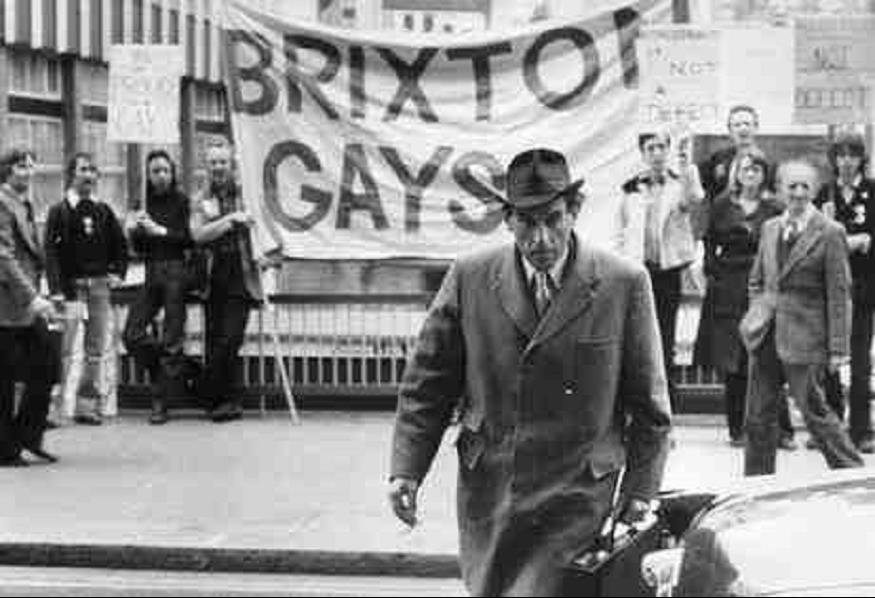
Jeremy Thorpe was forced to resign as leader of the Liberal Party and lost his seat as member of Parliament for North Devon. Arriving at the Old Bailey on charges of conspiracy and incitement to murder Norman Scott, his former gay lover, Brixton Gays picketed the court to challenge the notion of Thorpe's homosexuality as being a 'fatal flaw' in his character and to exhort him to come clean and 'come out' proudly as gay (1979)

A ‘mad axe man’ attacked people in the Gay Centre
Despite all of the problems mentioned earlier regarding the difficulties of finding a meeting place the SLGLF was not prevented from bringing together a solid core of political activists who were determined to find somewhere that would be secure enough to have complete control over matters. It was at this point, having been forced into a nomadic existence, that it was decided to squat a gay community centre. Opposition from more conservative elements, opposed to the theft of private property, was dismissed and the project went ahead. Initially after the first salvo of missiles from a marauding gang broke the gay centre’s windows further hostilities occurred.
The gay centre had an open door policy which meant any one could walk in off the street unhindered by entry requirements. This opened up the risk of hostile forces gaining access which happened on several occasions. The case of the ‘mad axe man’ will bear this out.
-
"That was the most serious attack we had. He'd been in a couple of times before because he lived or worked just down the road. A few doors down. I think he used to put his head in the door and hurl a bit of abuse. Then one early evening he came in and there were three or four of us there. He was very, very drunk. I felt that although he was being not sort of very nice, he'd come in because he really wanted to talk to us. I got the feeling that he was very screwed up and we had a very great attraction for him. We started chatting and then he quite suddenly turned very nasty. He got more and more aggressive. The more we tried to calm him the worse he got and then he picked up a chair and started attacking people and smashing up furniture. He was very, very violent and I was absolutely terrified. Eventually we overpowered him. I think we knocked him out. By then I think someone had phoned the police and they turned up. They took him to hospital because he had cut his head. I might say it was totally in self defence. Then they arrested all of us. Six or eight of us they took down to the police station and locked us all up. They kept us there I think until about midnight. Something like four or five hours.”
“The solicitor from the Law Centre (Lambeth Community Law Centre) came down but was refused access and told we weren't there. She was fobbed off. We weren't allowed to contact her and she wasn't allowed to see us. Some of us were interrogated. Philip (Felix) Alvarez was somehow selected to be interrogated. He was taken off on his own and slightly roughed up. Physically hit. I was put on my own in a cell because originally we were all put in one cell and the bloke who used to be the projectionist at the ABC cinema (Graham Mumford) was very distressed and shaking and I gave him a cuddle. A policeman looked through the spy hole and said 'Get Thornycroft out of there. He's touching them up.' So I was put in a cell on my own which I found pretty awful. Much worse than being with people. Then at midnight we were told to go and if we show our faces again we'd be in trouble. I went home but some people went back to the gay centre and an hour later the mad axe man with a bandage around his head came back with a meat cleaver. He started being threatening. By the time the police came again he had run away and gone into the place where he either worked or lived a few doors down. When the police were told this they said we can't go in there because we haven't got a warrant.”
“Next day we went to the police station to complain and they said 'You haven't been arrested. You have nothing to complain about. Go away otherwise you will be in trouble.' We got nowhere with that. I never understood how, if you are detained in a police station for several hours against your will, they can say you haven't been arrested. We then went to the law Centre and they said all you can do is to ask for a police report and then we will take it further. Six months later or so we were told the police refused to issue a report on the incident and so they couldn't take it any further. So what with the police and the Law Centre we were buggered and got nowhere at all. I don't think the mad axe man came back after that. I don't know why. Don't remember him coming back but I always worried that he would because it was the most frightening thing of my life. Certainly the nearest I ever came to killing anyone."
He was robustly built and possessed the strength of a giant. According to John Lloyd he shouted "It's against the laws of god" and with one swift and violent kick sent him, still seated on his chair, flying to the other side of the room.
Alex Beyer reported his feelings of unabated terror as he fled into a back room of the centre. The fracas began when a '"big, rough-looking" man came into the centre. His observation that "Oh, your gay" followed by "What's it like being gay?" was given the somewhat condescending reply of "Well, if you want to find out what it's like to be gay sleep with a man." This did not bring out the best in him. He freaked out and went away returning with an axe in his hand. With the battle cry "I'll kill the fucking lot of you" he brandished the axe as though he meant it. Alex ran off into the back. "I could visualise him burying the bloody axe in my head."
"He was a very big guy and he looked very, very angry. He pointed to somebody and said ‘You're dead!‘ I disappeared into the back of the centre and I didn't really know how I was going to get out, you know, because....I have this vivid memory of Bill (Thornycroft) smashing the man over the head with a chair to stop him which was very courageous. I don't know what happened. He went off and I think he was going to get a posse of people to do us all in. The police were called and a number of people were taken down to Brixton police station. I wasn't one of them. I was absolutely petrified."
One detective asked the detainees questions that had nothing to do with the assault: what were their political affiliations, who was involved in the running of the gay centre, who was their leader and so on. One gay centre user was offered a deal on the small amount of dope found on his person. He was asked again about who ran the gay centre, who used it and what kind of ‘illegal’ activities went on there. If he gave information on those matters he would be treated leniently regarding the exotic substance in his possession. Another gay centre user, who was experienced in articulating his rights by remaining silent, received a few hefty kicks for his trouble. Yet others were subjected to foul-mouthed, anti-gay abuse. One detainee was offered freedom if he had sex with a police officer.
No one was charged with any offence and after several hours in custody the detainees were released late into the night through the efforts of Lambeth Community Law Centre. Meanwhile during their incarceration the religiously-inclined, queer-bashing maniac had been discharged from hospital.
Later it was rumoured that the ‘mad axe man’ ran a second hand furniture shop a few doors down from the gay centre. At one of his visits to the gay centre he had expressed an interest in buying discarded furniture in the newly refurbished place. He may have had some connection to the fascist National Front. For some time after this incident a number of gay people walking up Railton Road and Mayall Road were confronted by sinister threats from people in cars. No-one was sure whether they were fascists of just police in unmarked vehicles. Whatever the truth of the matter those experiences helped to create an atmosphere of insecurity and fear with a need to be constantly vigilant against the possibility of future verbal and physical assaults.
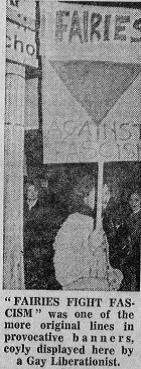
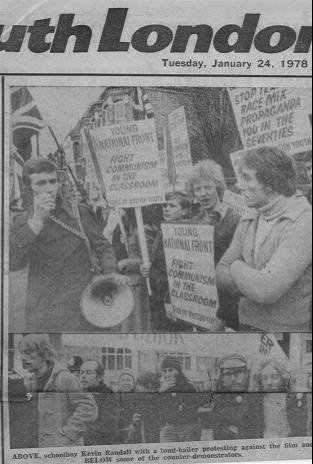
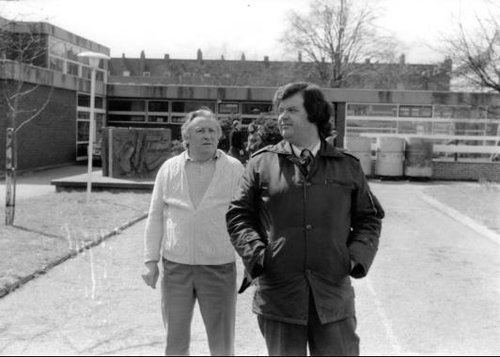
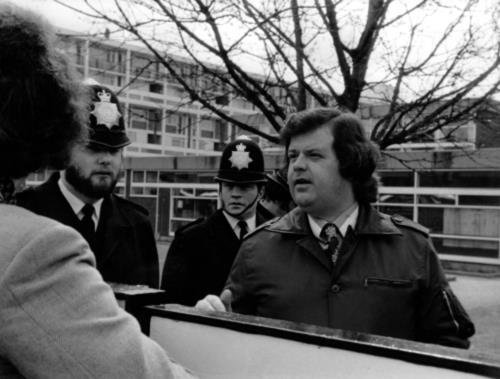
Martin Webster, former National Activities Organizer of the fascist, racist, sexist and homophobic National Front (now defunct), with his sidekick and violent thug Derrick Day. The occasion is a local election meeting at a primary school on the Angel Town estate, Brixton (1976). Webster was kicked out of the NF when his homosexuality became known.

People from the The South London GLF and the gay community centre demonstrated alongside other groups to close the meeting down and kick them out of town. Alastair Kerr holding a Fairies Against Fascism placard.
-
“While bathing in an empty squat at 94 Railton Road that had a working bath I heard the front door crashing in and hostile shouts. Stephen Gee had recently moved from the place because of hostilities from the local queer-bashing neighbours from hell. Working on the pure instinct of self-preservation rather than being beaten up I dived out of a back window stark naked only to cut my feet on broken glass. Limping to a neighbouring black family's house I was kindly supplied with a pair of trousers to cover my nakedness. On peering out of the front door before leaving the house, a gang of white men and women passed by and I recognised them as having given trouble to the gay community squats on previous occasions. A trip in an ambulance to Kings College Hospital was necessary where are nurse carefully picked out splinters of glass from the soles of two blood stained feet.”
Some time later the gang reappeared and threw an old television set, discarded on the street, through the front window of one of the gay squats at 152 Mayall Road. No-one quite knows how but the occupants had been pre-warned that something hostile might happen and a group of gay men rushed out of the front door. The attackers were chased along Mayall Road where they disappeared into a house. After a while and with indecison about what to do next half a dozen police cars arrived on the scene and it was left up to the police to deal with the situation. Again rumours flowed thick and fast that the gang were friends of the Mad Axe Man and National Front sympathisers. The neighbours from hell, so the apocryphal story goes, attacked a black family living next door to them who returned the favour and drove them out of the area. We never heard from them after that. Ironically the television set that provided ammunition for the gang had been thrown out by another of the gay squatters living several doors away.
Individuals from the gay squats were attacked on the streets especially those who were camp and more flamboyantly dressed. Others were the victims of street robberies and subjected to police entrapment while cottaging and received criminal convictions.
-
The police raided 157 and 159 Railton Road in the summer of 1977 and 146 Mayall Road on 20th February 1981. No-one quite knows why the police decided to raid the first two squats. Here's Julian How's account of the incident:
"The raid itself was really funny. I was actually in my room sewing a frock. I was in me knickers sewing a frock. Somebody came to the front door. I was thinking I'd better finish that seam. I opened the door and it was the police. I shut the door and behind me there was another policeman coming up. He said "We're the police!" and I said "Oh". So I pulled the door open, right, and got the back of this policeman and said "There's some of your friends through here". I pushed him through and shut the door behind him."
"Then this other policeman comes up the corridor and I thought, well I suppose you all better come in then. Then they found three rather dilapidated dope plants at the top of the house somewhere…I think on our roof...I told them I had to go and get a frock and some lipstick so they escorted me back in to get a frock and lipstick and they pulled us all into the kitchen at 159 (Railton Road). They said - look at least one of you has got to take the rap for these plants...Originally we were going to say we were all responsible. Fourteen people altogether. But the problem is one or two of us had suspended sentences for other things. We were a bit frightened because some of us might have been classed as illegal immigrants. So if they had charged all of us with it that would have all come out and we would have got done very disproportionately. So Petal (Peter Cross) turned around and said "I grew the plant". We actually decided at the police station that Petal was going to cop for it. That's effectively is how that happened. As far as I know."
-
"Petal - he and I shared a particular experience: getting busted for Jane’s dope plants! Jane was growing marijuana plants in the back garden, in pots (mad). On the first day we had ever spent apart (she’d gone to her parents’), the two houses got busted: 159 and next door. The police wanted one person from each house to take the rap, so Petal and I took it and went off in the black Marias. We managed to get a very good lawyer through Release: Mike Fisher - he of the Birmingham Six defence, whose cases he’d just taken on. Both Petal and I had recently had nervous breakdowns, and Mike presented our case to three ‘Worthies’ at the Magistrates Court as two vulnerable young people who’d made a mistake. We got an eighteen month suspended sentence each. Petal and I went to a cafe afterwards with Mike Fisher and had a cup of tea."
Rosemary and Jane Runnalls, her partner, formed the lesbian feminist band 'Ova'. They lived at 159 Railton Road after they had been rescued from homelessness by Jamie Hall. Jamie died in 1985 from AIDS related illnesses and they recorded one of his songs on their first album and Jane wrote a song about him on their last album.
"Jane and I lived there for three months in that amazing summer of 1977. In my writings I always thank the men there for their kindness to us. Jane and I had been beaten up in the squat we lived in in North London. Jamie was present at the end of the attack - he’d been visiting and missed the last bus back to Brixton, and when he came back to our squat to crash, the attack was in full flow. He intervened when, after our attackers left, the local hippies verbally laid into us, more or less saying we'd got what we deserved. Jamie shut them up, and because Jane and I had, literally, nowhere to go, he invited us to stay in Railton Road. That’s where we learned about sexual politics, homophobia, etc. I will always be grateful to those young men who showed us such kindness. I mean, they were a gay male community, but they took us in. I’m so glad this is getting written up. It was an extraordinary era."
Peter Vetter has a slightly different version of this episode....with Peter Cross’s and Jamie’s(!) arrest. He highlighted the embarrassment of being discovered in bed by police or sitting around the garden in drag after an event at the gay centre when they came swarming over (the garden). People had to decide in twenty minutes who would take the blame for the dope plants avoiding confessions from those who already had a criminal record and anyone from another country to avoid the risk of deportation.
During the raid on 146 Mayall Road, after cursorily flashing search warrants which the inhabitants had insufficient time to read, the police made it clear that they were looking for drugs and stolen property. Michael King, Tony Smith and Steve Ewart (Craftman) were summoned out of their beds at about 7.30am by loud knocking and banging on the front door. Tony Smith noticed from his bedroom window their attempts to kick the front door in. Five plain clothed policemen from Brixton station searched various bed rooms and the basement kitchen. Michael King noted that they were more interested in 'letters and papers' while searching his room and made homophobic comments. They found nothing incriminating and took nothing away. They left after about half an hour and no charges were brought against anyone.
In a later statement about the raid it was made clear that the squat was part of the Brixton gay community housing of around 35 gay people and the base for Gay Liberation South London and the Brixton Faeries theatre group. Recently the squat had housed the 'administration' of the radical newspaper 'Gay Noise'. The implication of this was that the plain clothes police were more interested in the politics of the group than the search for drugs and stolen property and, despite no charges being brought, that the raid was a form of low-level harassment and intimidation.
-
Inevitably any organisation seeking to grow and prosper finding funding became a necessity. Almost a year and a half of struggling to meet payments of electricity and telephone bills and to find money for refreshments and other expenses through staging discos and dances proved insufficient to cover costs. Without a formal membership and subscriptions system inadequate collections were taken at weekly collective meetings. To remedy this situation a decision was made, in October 1975, to apply to Lambeth Borough Council for a small grant to cover basic running costs. The grant was for £1797.00 annually which included projected costs for rent and rates (council tax). A much larger sum of £4470.00 was claimed by the Women's Place next door to the gay centre which included a full-time worker/playgroup leader. All gay centre organisers gave their labour on a voluntary basis. The Women's Place application was approved but the gay centre's was rejected. Before discussing the rejection it's worth looking at the case for a grant made by the the South London Gay Community Centre. This gives a snap shot into the politics of the South London gay liberationists at the time.
The gay centre grant application considered by the Community Liaison Sub Committee began by quoting the London Medical Group Research Department's figures that one in eight people in London were homosexuals. This statistic indicated that many thousands of Lambeth residents were also gay and was followed by an assertion that would raise hackles nowadays but at the time was not considered to be controversial:
"Homosexuals in this society are very much in the position of Jews in a fascist state. They live in a constant state of fear that if their homosexuality becomes known they will be disowned by their family, rejected by their friends and sacked from their jobs."
In 1974 most of this statement was true. The police continued to raid gay saunas, pubs, clubs, cottages and cruising grounds. Under the age of twenty one gay men could still be prosecuted for illegal relationships and laws such as importuning for an immoral purpose or gross indecency were used to arrest gay men (and still can be!). Those who were prosecuted and subjected to pubic exposure were ostracised as social pariahs. But nowadays, in the increasing febrile atmosphere of trolling and witch hunting, to equate LGBT+ oppression to the Nazi state policy of mass antisemitic racism, incarceration, mass murder, the destruction of civil liberties, property confiscation and exclusion from employment would be seen at the very least a gross exaggeration and at most a form of antisemitism in minimising and devaluing the deaths of millions of jews exterminated in the holocaust. Gay men also died in Nazi concentration camps but it would be seen as outrageous to suggest an equivalence between the two. Most that can be said about this is that it was a deliberate rhetorical flourish to emphasise the extent and depth of gay oppression that had not even appeared on the radar screen of most politicians and public bodies.
The statement goes on to illustrate the various strategies gay men were forced to adopt to carve out a safe space in society in ghettoised jobs such as hair dressing and the theatre. One survival strategy was to play stereotypes ridiculing gay men for the amusement of others. They were viewed by gay liberationists as the equivalent of 'uncle Tom' figures to gain limited acceptance by 'straight' society quoting Larry Grayson, Danny La Rue, Kenneth Williams and Stanley Baxter as equivalents to 'eyeball-rolling, water melon eating blacks who played inferior 'comical' roles in pre-war American movies and reassured society of white superiority.'
'Most homosexuals', continued the submission, pretend to be heterosexual even to the extent of getting married to quash suspicions about their continued 'bachelorhood'. Further, to avoid detection they also remain 'closeted' at work, in the street, in political groups and the family out of fear of adverse reaction should their sexual orientation become known.
The statement continued by emphasising the absence of any positive endorsement of homosexuality at school, in the media, books, television and films leading to isolation during childhood and adolescence and a 'lack of identity' with the assumption that everyone is heterosexual (and white as well).
The statement went on to explain how the pubs and clubs exclusively for homosexuals, mostly confined to large cities, were exploitative (charging high prices), repressive and tension ridden. Although they provided a short respite from pretending to be heterosexual, cramped into a few 'frantic' hours of social existence, these ghettoes were subjected to raids by the police and individuals were harassed by them on leaving the places quoting the Colherne and Boltons in London's Earls Court as examples.
A case tor the Gay Community Centre is then made as an alternative to the established and unfriendly gay scene emphasising the need for a relaxed and friendly atmosphere to provide a supportive background where gay people could 'be themselves.'
The statement continued with the following points:
The gay centre is not a club with a membership but a community centre similar to Women's Aid (state funded) or centres for disadvantaged black youth.
Young people rejected and thrown out by their parents and an unfriendly gay scene needed an alternative place to socialise to stop the drift into the West End of London and prostitution.
Rose Robertson of Parents Enquiry (also funded by the state) and the independent Icebreakers Collective were on hand to liaise with parents and rejected youngsters to repair relationships and to provide a specifically gay youth group. Both assisting the turn away from drugs and suicide and protection against abusive parents.
Older, middle-aged gay people rejected by the commercial gay scene were not only lonely as a result of this but had to 'shake off a lifetime's habit of guilt and shame.' The gay centre would provide a place of acceptance, friendship and relaxation in the company of other gay people.
With the major problem of gay people being sacked from their jobs and the reluctance of trade unionists to support them, citing a midwife and a teacher as victims, a Gay Workers' Group had been set up 'in several parts of the country' with the express task of producing a Gay Workers' Charter in a similar vein to the Working Women's Charter proposed by the Women's Place next to the gay centre that had also applied for a grant.
The gay centre telephone service provided a lifeline for gay people in various states of worry and despair including fears of suicide. Calls were even handled after midnight by Alastair Kerr who lived above the gay centre.
The USA, Canada and the Scandinavian countries were years ahead of Great Britain in the public provision of Gay Community Centres in major cities as they were in tackling women's equality, black liberation and gay rights.
Gay people contribute to society in terms of paying rent and rates hence the time is overdue for public funds to be made available to counteract gay oppression by funding the gay community centre, the first of its kind.
The grant application was vigorously supported by Ken Livingstone and Ted Knight who were then Lambeth Labour councillors. Knight later became leader of Lambeth Council and famously defied the Thatcher Tory government against rate capping. Livingstone later became the Mayor of London and Member of Parliament for Brent East. As head of the Greater London Council he fully funded the first officially backed Lesbian and Gay Centre at Farringdon Road though castigated at the time as part of the 'loony left' by the reactionary press and Tory government.
The grant application was given further support by a number of Left Labour councillors, Area 5 Social Services and Lambeth's Council for Community Relations. Testimonials of support were also given by the Campaign for Homosexual Equality, London Friend and Icebreakers. The grant application was however defeated on the spurious grounds that the extra money needed for the gay centre grant could not been budgeted for in the following year’s financial projections. But clearly this did not stop the community liaison sub-committee from allocating funds to other groups that had not been anticipated in forthcoming financial projections such as the Womens' Place which had applied for funding at the same time as the gay centre.
There was opposition to the grant from both conservative and right-wing labour councillors but the most vocal challenge from members of the public came from Beatrice Old the landlady of the George public house. Standing conveniently near to the gay centre this pub became the watering hole for centre volunteers and users. Recalling a prior confrontation with gay liberationists at her public house she resolutely opposed the grant. Some customers had objected vociferously to gay men kissing as the customary greeting and holding hands. A fight broke out and the gay liberationists were barred. At this point in time the South London Gay Liberationists had been thrown out of practically every bar on Railton Road and surrounding areas which considerably decreased access to public spaces in which to socialise.
In fact almost a year earlier in November 1974 at the Hamilton Arms on Railton Road gay liberationists were barred by the landlord. This time action was called and insisting on the right to socialise anywhere to counter bigotry and prejudice an occupation of the pub was arranged. A squatters’ group which met at the Women’s Centre had been attended by several gay people. The squatters and one or two left-wing labour party councillors from Lambeth Council demonstrated their solidarity by joining the occupation. David Callow had made the rounds of kissing his gay comrades with the usual gay liberation disregard for the misery of the closet. He and some other gay men were promptly asked to leave the building for such a wanton display of gay audacity was not appreciated by the bar manager. The sit-in was eventually defeated as the protesters were ejected out onto the pavement by the police.
Mrs. Beatrice Old cited the fracas in her public house as part of the reason for her opposition to the grant. That and the strange way that people dressed and acted. The make-up and women’s clothes on men was one thing. But kissing too! The fight in the saloon bar of the George Hotel after taunts and insults from some young men and a few older regulars led to the ban being imposed. Rowland, one of the gay centre users, adopted a laddish pose and threatened to take on anyone who dared to challenge him. Table and chairs were overturned in the best of Western saloon bar traditions and the errant gay libbers were thrown out. A picket was later mounted outside the George with banners protesting again discrimination on the uncharacteristically chilly Friday evening of 5 September 1975 with few customers braving the cold to go into the pub.
Mr. John Old, the landlord, was adamant in refusing admission. In his statement to the South London Press he insisted that kissing and cuddling between men would not be allowed in his pub. He would not let men and women do that let alone men and men and his customers had threatened to desert him. The matter of being barred from other pubs in the area was also mentioned in passing. Beatrice Old and husband John however failed to mention that they had been prosecuted under the Race Relations Act for banning black people from their pub. There were no laws against discrimination on the grounds of sexuality hence bans were permanent for LGBT+ people.
The grant application was rejected and rumour upon rumour suggested that Mrs. Beatrice Old tumbled down the steps at the front of Lambeth Town Hall as she was leaving the committee proceedings. Did she fall or was she pushed? Certainly a chair was thrown at her after the verdict. Beatrice Old entered the Brixton Faeries’ theatre group hall of infamy as a character in one of their plays. She was portrayed as sour-faced Mrs. Mold in ‘Mr. Punch’s Nuclear Family.’ The failure to get a grant prompted the production of a poster condemning Lambeth Council's homophobic decision which was fly posted throughout the borough. Later a play was written and staged in 2021, 'On Railton Road', using 'Mr. Punch's Nuclear Family' as the centre piece around which to explore the lives, loves and political controversies of the Brixton gay squatted community in the 1970s.
A leaflet was also produced at the time that was shot through with an eclectic mixture of gay separatist arguments tinged with quasi-Marxist analysis and liberal demands for civil rights. Stress is laid on strength through numbers and the need to gain acceptance through greater visibility. It is worth quoting in full to gain a flavour of the ‘spontaneous’, haphazard and sometimes vitriolic nature of gay centre propaganda at the time. The errors in grammar and punctuation reflect the 'hurried' and careless nature of activist propaganda with little time for editing.


Outside the Royal Courts of Justice in the Strand. Demonstrators and members of the National Gay News Defence Committee in solidarity with 'Gay News' at the appeal against the conviction for blasphemous libel. Front row right to left: Unknown, Ian Townson, Julian Hows, Edwin Henshaw, Richard McCance, Terry Stewart. The rest Unknown (1979)


This poster, transforming Lambeth Town Hall’s clock tower into a ‘f..k off’ sign demonstrated the Council’s contempt for LGBT+ people and was flyposted over parts of Lambeth as a protest at the grant application rejection.

-
“Though recognising the urgent need for law reform in Parliament, real change will only come from a change in the people’s attitudes (and by ‘people’s attitude’ we also mean the attitude of gay people towards ourselves, our rights as citizens and an angry recognition of how we have been deprived of these”
“A recent survey of the London Medical School's Research Dept., places the number of gay people at 1 in 8 of the population of London; 1 in 10 elsewhere. That is at least 5 million people in Britain; 900,000 in London.”
“If every gay person was on this march, we would be immobile fro Speaker’s Corner to Trafalgar Square, and every street in London would be blocked by us. (and then they’s probably bomb us!)
“Despite our vast numbers only a minority of gays are “involved” in gay groups, and this energy is largely ‘internalised’ ... i.e. directed into social channels of dances, etc. A great many gay people have no regular meeting place apart from the commercial gay scene - a scene that does not really lend itself to building up the strength, pride and self-confidence necessary to a civil rights struggle.”
“For gays in South London this was frustratingly true until the setting up 2 years ago of the SOUTH LONDON GAY COMMUNITY CENTRE. Since then, with our own home open every evening of the week, we have been able to build up s strong local gay group. The support and identification that has come from having our own place has enabled us to make a contribution to the gay movement far in excess of our actual numbers.”
“For gay people locally, and not so local, it is a place to come to for friendship, relaxation, support and sympathy. Increasing numbers of quiet, shy gays use the centre regularly gaining self-confidence. Many come out.”
“From our experience, we have come to believe that the most positive way for gay people to organise for our many needs is by creating such centres. Others - (in our out of Parliament) - will not do it for us - WE MUST DO IT OURSELVES.”
“Change is not only required from Parliament. Real change in our lives must be effected on the home front, i.e. where we live and work.”
“Gay people are part of their communities. At least one tenth of ratepayers are gay. Virtually all are tax-payers. And what service do we receive for our contribution? Society is organised to cater for the needs of heterosexuals only. Public money (£113 public money) is spent on their children; their housing; their police; their libraries; their marriage guidance bureaus(and their divorce courts ! ) and medical services which deny us our sexual orientation.”
“Lambeth Council have spent £ 13 MILLIONS on Social Services this year. We, at Sth. London Gay Community Centre, have asked for £2000 (.016 of 1 percent for 12 and one half percent of the population) to pay back to them the rent and rates they ask form us.”
“Our city-fathers, shuddering at the concept of “LAMBETH/HOMOSEXUALS” have refused us. This is now building up to a major council row, in which we have the support of many individual councillors. We are glad of this, as now, with all the attendant publicity, all the 30,000 gays in Lambeth must know of the Centre’s existence, and after tonight's television programme about us(see below) a great many more will know.”
The statement ended with information about our appearance on London Weekend Television’s ‘The London Programme’ one of the earliest public access programmes creating an opportunity to ‘speak for ourselves’. A dance was organised at Hammersmith Town Hall together with Bradford GLF’s production of ‘Present Your Briefs’ to help raise funds to pay the centre’s emergency bills. Despite these efforts the lack of regular and secure funding in part contributed to the South London Gay Community Centre's demise and closure.

Terry Stewart dressed as Mary Whitehouse at the Gay News Appeal against the conviction for blasphemous libel. The banner holders, right to left, are Brinley Mitchell, Paul Morland, Edwin Henshaw and Stephen Gee. The rest Unknown. The banner was made by the Socialist Workers' Party gay group and to the bemusement of the police man it depicts men cottaging as the police and Mary Whitehouse spy on them secretly in readiness for entrapment (1979).