
Covering the wider militant and uncompromisingly radical fight back against exploitation and oppression in which LGBT+ struggles were situated in the 1970s

CHAPTER 2.
Wider Background & History
Let’s begin with framing a brief picture of major events during the florid or hot house era of the nineteen seventies - a period that was very different from the one we know in the twenty-first century and one in which the Gay Liberation Movement grew to fruition.
1970s Britain was saturated in political activity right across the board. Not just in the labour movement and the left, but in the environmental, countercultural, squatters' and claimants' organisations who were also fully engaged in defending people against poverty, homelessness, and the destruction of the environment. Many campaigning groups were also experimenting with 'alternative' ways of living. Throughout this period the anti-apartheid movement, the anti-Nazi League and Troops Out (of Ireland), challenged the racist regime in South Africa, the growing menace of racism and fascism and the continuing British military occupation of the North of Ireland against Irish nationhood and freedom. In the early 70s there were also lively anti-Vietnam war demonstrations. These 'new' social movements were particularly active in challenging the oppressive established order, especially the black people’s organisations, and the women's and gay liberation movements. This ferment formed the crucible of radical and revolutionary activity within which the prominent ideas and experiments took shape in Brixton, especially in gay liberation and feminist circles.

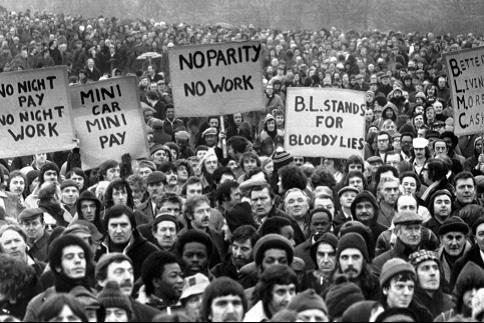

1970’s was saturated in strike action for workers rights.

Edward Heath, the Conservative prime minister from 1970 - 1974, created the Industrial Relations Act (1971). The Act was designed to shackle the trade unions but two miners’ strikes in 1972 and 1974 forced the Tory government to fall which was then replaced by Harold Wilson’s Labour government. Image from The Guardian
In 1971 there were strikes and demonstrations against the Industrial Relations Act which had been introduced by Edward Heath in an attempt to shackle trade unions by placing restrictions on collective bargaining and strike action. The miners' strikes of 1972 and 1974 leading to power cuts and the three day week raised the question of 'who governs Britain' which was answered by the defeat of Edward Heath and the Tory government. The incoming Labour Government of Harold Wilson repealed the act. Radical drag queens from the Gay Liberation Front showed solidarity in 1971 with the mass demonstration opposing the act organised by the trade unions and the Left. They received a 'mixed' reception with some hostile reactions and were forced to occupy the back end of the demonstration. One anti-gay chant, “ee ey addio Teddy is a queer”, berated Prime Minister, Edward Heath, for being a 'bum boy'.

Roughly 10,000 school students went on strike in 1972 against corporal punishment, uniforms, authoritarian head teachers and exams. The National Union of School Students was the main organisation but the smaller and more militant Schools Action Union fought to build solidarity between teachers and students to run the schools.
-
There were school students' strikes in 1972. The pupil power demonstrations against corporal punishment, uniforms, authoritarian headmasters, exams, and for greater democracy and free speech were led by the National Union of School Students and the more militant Schools Action Union with its leaders sporting Chairman Mao badges. About 10,000 students came out on strike with mass gatherings in Hyde Park Corner followed by a march and rally at County Hall the HQ of the Inner London Education Authority. Julian Hows, who later joined the Brixton Gay Community, enthusiastically took part in the strikes as a 16 year old school student from Tulse Hill Comprehensive boys' school. A year later students from the school attacked a nearby gay commune forcing the radical queens to vacate the premises and move elsewhere.

Photo taken at a anti-Vietnam war demonstration in roughly 1968. The two people in the foreground are Tariq Ali (famous political militant and member of the international Marxist group) and Vanessa Redgrave (a famous actor and member of the Workers Revolutionary Party). Tariq Ali was also the author of 1968 and After: Inside the Revolution. Demonstrations against the war continued into the 1970s until the USA was defeated and forced to withdraw in 1975.
Photo by Lewis Morley

Photo at an anti-Vietnam war protest in 1968.

Some from the Brixton gay community squats were involved in the Troops Out movement protesting against the military occupation of the North of Ireland by the British army. These protests were in solidarity with the Irish people and the Republican movement for a United Ireland free from British Imperialist rule. People in the photograph unknown.

L-R holding banner: Tarlach Mac Niallais, Cathal Ó Ciorragáin, Máirtín Mac an Ghoill. Not sure of the location but it may have been Lisburn near to where the Maze prison ('H' blocks) was situated.
-
There were still sizeable demonstrations against the USA's cruel and devastating imperialist war in Vietnam and other parts of Indo-China. America was finally defeated and forced to withdraw in 1975.
The Troops Out Movement actively fought for Irish freedom and a united Ireland against military occupation by the British throughout the 1970s, which persisted well into the nineteen-nineties. They also demonstrated against internment without trial and to free Irish political prisoners. Bloody Sunday in January 1972 was when British troops gunned down 13 unarmed civilians. The unrelenting Thatcher government caused the death in prison of ten hunger strikers including Bobby Sands who was elected as a member of the British Parliament before his death. According to Nettie Pollard’s memories Jamie Dunbar, a member of the Brixton gay community, travelled to Belfast as part of a Troops Out delegation. He took part in the first gay pride march there and lived for a while in the city’s Divis flats, setting up a video production project.

Anti Fascist movement of 1970s

Attack by fascists on the Royal Vauxhall Tavern
-
Fascist parties and movements were especially active in the 1970s. Notably the National Front and the British Movement. To counter the rise of these violent racist movements for white supremacy the Anti Nazi League was established and was active into the early 1980s. The ANL inspired the creation of Rock Against Racism to capture and engage a more youthful audience. Gay venues such as the Vauxhall Tavern were attacked by the NF and their 1976 election meeting at a primary school on the Angell Town estate in Brixton was picketed and disrupted by demonstrators. South London Gay Liberationists joined the picket line with their banner and ‘Fairies Against Fascism’ placard. In 1977 The NF organised a provocative march through Lewisham an area with a large black population. The march was disrupted and defeated by opposition from the left but importantly also from black and white youths many of whom were joined by local residents from neighbouring housing estates. A large lesbian and gay solidarity contingent was there including people from the Brixton Gay Community.

Photograph of Jayaben Desai the leader of a mostly Asian women's workforce at Grunwick’s film processing factory in North London. The workers went on strike and tenaciously fought a two year long battle from 1976-78 for the basic right to belong to a trade union. This strike got mass support especially from the National Union of Mine Workers.
-
From 1976-78 Asian workers at Grunwick, a film processing factory in North London, went on strike for the basic right to belong to a trade union which was vigorously opposed by the owner, backed by the National Association For Freedom, a free-market, anti-union organisation led by, among others, an aristocrat (a viscount no less) and a high-ranking army officer. The 'freedom’ for employers to exploit whoever they like, whenever they like and under whatever conditions they like was opposed by a workforce composed mainly of Asian women under the exceptional leadership of Ms Jayaben Desai. The strike had mass support drawn from many unions and the left. Gay people from Brixton also stood on the picket lines and Bill Thornycroft had clear memories of being thrown into the back of a van by members of the Special Patrol Group riot squad. He bravely asked why they were so violent, and they replied “We’re geared up for it.” Eventually the TUC and Apex, the main union for Grunwick workers, withdrew their support and the strike was defeated.

There were demonstrations against the racist Apartheid regime in South Africa. The anti-apartheid movement was active in the 1970s and continued well into the 1980s and 1990s. Sanctions were demanded from various governments but were rejected. Despite this the movement boycotted sporting events such as the all-white South African cricket and rugby teams and also called for consumer boycotts.
-
In solidarity with the African National Congress and COSATU, the main trade union Movement in South Africa, the Anti-Apartheid Movement was active from the 1970s right through to the end of the 80s against South Africa’s racist regime. Fighting for sanctions, consumer boycotts and picketing rugby and cricket events against visiting SA teams for excluding black players the hypocritical idea that sport should be kept out of politics was simply ignored.
-
In 1978-79 the 'Winter of Discontent' saw many strikes and demonstrations against James Callaghan and the Labour government's Social Contract (1). Characterised by workers and trade union leaders as the 'Social Con Trick' stagflation had led to crippling levels of inflation and a collapse in investment in industry and commerce; The Labour Government, for the first time in British history, had to submit to conditions imposed by the International Monetary Fund for privatisation and cuts in public spending to secure a bail-out loan. As a consequence, the government attempted to rein in the trade unions through wage cuts, and by undermining strike action and collective bargaining. Workers refusal to shoulder the burden of the capitalist economic crisis resulted in a resounding wave of strike after strike across the entire economy.
-
Concern over climate change and the disastrous consequences of environmental degradation took off significantly in the 1970s. The Ecology Movement and the Ecology Party eventually became the present day Green Party. As a result of this decades long struggle governments globally have become alerted to the annihilating effects of carbon emissions but sluggish in combatting them. Many on the left are clear that government’s dominated by the interests of profit-driven investment banks and corporations will never be up to the task of countering global climate catastrophe. Consequently, they argue that workers in the polluting industries drawing up worker-led strategies for alternative forms of green energy along the lines of a new Lucas Plan(2) is the only way forward.
-
“Turn on, tune in, drop out”, Dr. Timothy Leary.
The older cultures of bohemians and beatniks, the Beat Generation, had given way in the 70s to a dream of ‘Peace’, ‘Love’ and mind altering drugs. Imitating older Utopian visions of building a just and liberated society in the here and now there was an attempt at establishing alternative societies free from straight (jacket), uptight system of respectable, bourgeois normality. Hippy communes were established as a counter to the stifling morality and conservative social conventions of previous generations. Largely Middle Class in origin the movement was often characterised by critics as driven by tree-hugging, nature-loving drippy hippies naively living in a Utopian fantasy land. Other alternative movements turned to Eastern religions for spiritual enlightenment. A more damning criticism of the counter culture was its lack of serious political analysis. ‘Letting it all hang out’ did not challenge male chauvinism and the oppressive treatment of women within those alternative societies. The struggle for women’s emancipation was not on the agenda nor were attempts at solidarity with other oppressed groups or working class struggles. They simply were not recognised in a movement that was mostly concerned about ‘personal growth’ and inter personal relationships as a way to liberation rather than engagement with wider political concerns.

Photo of the 1983 Ecology Party Manifesto


-
The positive value of this form of social experimentation consisted of creating an alternative space which allowed people to develop political, cultural and social awareness outside of conventional strictures; these were breathing spaces for creative artistic expression. Alternative lifestyles also attempted to challenge the nuclear family and private property for a more collective solution to exclusivity in relationships, possessions, and child rearing. Challenges were also mounted to orthodox psychiatry by the anti-psychiatry movement through influential radical figures such as R. D. Laing who attempted to discover social causes of ‘madness’ in the family and established drug-free therapeutic communities. Arthur Janov’s primal therapy looked to alternative forms of personal growth and mental well-being. Other alternative societies looked to Eastern religions for spiritual enlightenment. 'Underground' newspapers outraged conventional, bourgeois morality and created a space for alternative groups to publish articles, contact addresses and art work.
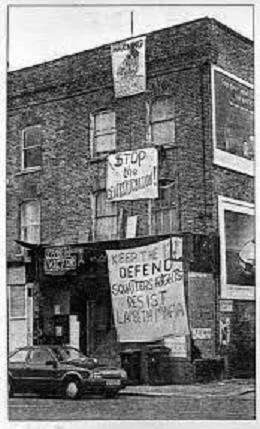
Fighting eviction! The 121 Centre at 121 Railton Road, Brixton, in 1999. Photo from Past Tense Blog.

Banner from the Brixton rally against eviction in Windrush Square (2013) where residence of Rushcroft Road community among others fought for their right to stay. Photo from Brixton Buzz.

Olive Morris resquatting 121 Railton Road after an eviction attempt. The photo became the front cover of the 1979 edition of the Squatters’ Handbook.
-
The squatters movement in the 1960s and 70s echoed the original movement of ex service men, women and families occupying empty properties to house themselves immediately after the Second World War. By 1974 there were over 30,000 squatters in London alone, responding to homelessness and the housing crisis, but also in opposition to private property and landlordism. Squatting drew attention to the thousands of empty, unoccupied buildings in London and the inability of most Labour Councils to house the homeless (with over 21,000 people on the housing waiting list in Lambeth alone). Brixton and in particular the area in and around Railton Road where the gay squats and gay community centre were located was blighted by a long-delayed and frequently postponed redevelopment scheme leaving many houses, cleared of residents, empty and ripe for squatting. In other parts of Lambeth practically whole streets had been squatted such as Villa Road and St. Agnes Place. Squatters groups also created community food co-ops, cafes, free advice centres, bookshops, centres for meetings, music gigs and parties and many other social facilities.
Despite decades of protest at the housing crisis since the 1970s the contemporary situation is getting worse through the right to buy scheme stripping away council housing and government restrictions on house-building by local councils in favour of private developers. Squatting in residential dwellings was made illegal by the Tory Justice Minister Christopher Grayling in 2012 which has only served to exacerbate homelessness. With chronic and widespread poverty in Lambeth mortgages and private ownership were out of reach for many.

There were many Student strikes, demonstrations and ‘sit-ins’ throughout the 1970s

Student protesters in one of the many occupations/sit ins.
-
The student movement fought for radical reforms in higher education but also sparked off issues that other organisations did not necessarily engage with. This fed into trade unions and the labour movement encouraging a move away from a focus on economic questions to wider interests such as anti-imperialism (Vietnam, Ireland), the anti-apartheid movement and the women's, gay and black liberation movements. Practically every university and many colleges established gay, feminist and anti-racist societies.
-
The Black Civil Rights Movement of the 1960s and the more militant and revolutionary Black Panther Party fought vigorously against structural racism in America. Inspired by Dr. Martin Luther King jr and Malcolm X the mass movements and radical organisations they inspired placed the struggle against racism at the forefront of the political agenda and inspired both the Women's Liberation Movement which in turn influenced the struggle for Gay Liberation.

Justice for the New Cross Fire victims in which 13 young black people died after an arson attack. It was treated by the police with indifference and neglect. The Brixton uprising against the stop and search laws, police brutality, harassment and deaths in police custody of black people came later in April of that year (1981)


The Women’s Liberation movement went beyond demands for equal rights in the struggle for freedom against capitalist patriarchy.
-
The Women's Liberation Movement from the late 60s onwards struggled for freedom and emancipation from patriarchy and capitalism. Challenging traditional sex roles the main demands were for women's control over their own fertility including free contraception and abortion on demand. Many other demands included paid domestic labour with the more revolutionary demand for socialised housework and child care, an end to sexual and domestic violence against women, and equal pay. There were also challenges against sexism and oppression embodied in the fight against sexual objectification by the pornography industry and the 'meat market' of the Miss World Competition. Lesbians were initially rejected by the WLM mostly on the grounds that they did not have sexual relationships with men and did not give birth to and rear children therefore they were not subjected to the same patriarchal oppression as straight women. After protests from radical lesbians this was later abandoned in favour of participation. Their brand of radical feminism demanding that all women become 'political lesbians' as the ultimate way of overthrowing Patriarchy and male rule was not welcomed by many in the WLM.
The Gay Liberation Front was formed in keeping with the rebellious and mutinous spirit of the times by two Maoists, Aubrey Walter and Bob Mellors, at the London School of Economics and Political Science in 1970. Both had visited the USA and were mightily impressed by the 1969 Stonewall riots led mostly by street transvestites and poor youth. This prompted the proliferation of lesbian and gay groups across America. The revolutionary and radical approach of the GLF contrasted with the more reformist one of the Committee (later Campaign) for Homosexual Equality in the UK which concentrated mostly on law reform and reforms in education though with more radical elements subsequently taking to the streets.(3) Two main publications came out of the Gay Liberation Movement - Come Together and Gay News.
Come Together with the cheekily outrageous triple meaning of collective action against oppression, sexual intercourse and a Beatles song of the same name indicating the latter, contained for many people the more revolutionary moment in gay Liberation history from 1970-73. Selected editions of the magazine were brought together in a book edited and introduced by Aubrey Walter (4). The style of the magazine clearly indicated countercultural influences found in publications like IT (International Times), Oz and Frendz with lurid psychedelic colouring and, among other things, intriguing experimental artistic layout. Frendz was notable for outraging bourgeois public decency and being prosecuted for carrying gay contact ads.
Gay News was established in 1972 and carried news items, feature length articles and contact ads. The magazine was taken to court in 1977 with a prosecution instigated by Mary Whitehouse.(5) on a charge of blasphemous libel for carrying a poem by James Kirkup(6). The National Gay News Defence Committee (which later became the Gay Activists’ Alliance) was formed at one of the gay squats on Railton Road.
So, the 1970s saw an explosion of increased militancy from political parties on the Left, and a huge expansion in social movement activities. Most social movements were a continuation of groups established in the 1960s. Some were influenced by the labour movement and by political parties on the left, whereas others avoided engagement with existing organisations. This refusal to be hitched to the wagon of established outfits resulted from the need for an autonomous existence on a clear platform against particular forms of oppression most of which were either ignored or sidelined by the left and the wider labour movement.
Sources
For a fairly decent account of the 1970s read When The Lights Went Out: What Really Happened to Britain in the Seventies by Andy Beckett. Faber & Faber Ltd. 2009
The Lucas Plan was developed by workers at the Lucas Aerospace Corporation for the manufature of socially useful ‘green’ products to replace armaments. The plan was perfectly feasible but rejected by bosses because it challenged their power with the threat of workers’ control of the industry.
CHE - Amiable Warriors by Peter Scott Presland. A fascinating history of the Campaign for Homosexual Equality that challenges the accusation by Gay Liberationists that it did little beyond lobbying for law reform.
Come Together: the years of gay liberation 1970-73, Gay Men's Press 1980
Ban this Filth!, Letters from the Mary Whitehouse Archive, edited by Ben Thompson, Faber & Faber Ltd. 2012. The chapter on 'Mary and the Blasphemers' deals with the letters and tactics around the prosecution of Gay News.
For an account of the prosecution and the poem itself which is still illegal see Pink News at: https://www.pinknews.co.uk/2008/01/10/the-gay-poem-that-broke-blasphemy-laws/