Our second play 'Out of it' deals with a gay boy growing up in a conservative, working class family with parental nostalgia about imagined past certainties feeding into resentment about present realities. All within a contemporary situation of a growing moral backlash against permissiveness and the rise of racism and fascism.
-
MOTHER - Edwin Henshaw
FATHER - Terry Stewart
GAY BROTHER - Ian Townson
STRAIGHT BROTHER - Stephen Gee
BOY - Alastair Kerr
CHAIRMAN - Terry Stewart
ROSS McTWITTER - Alastair Kerr
ANOTHER FATHER - David Simpson
ANOTHER CHAIRMAN- Alastair Kerr
DR. FIELDS - Bill Thornycroft
NATIONAL FRONT MAN l - Bill Thomycroft
NATIONAL FRONT MAN 2 - David Simpson

By the time we had got round to our second production we had changed our name to Gay Liberation South London Theatre Group. The word 'Front' had been dropped because, so the argument went, it sounded too authoritarian or fascistic as in National Front to be included in our name.
This production was much more sophisticated and varied in terms of structure and themes and clearly responsive to wider currents of a more public and explicit opposition to gay people. "Out of It” attempted to expose gay oppression expressed through different ideologies - political, religious, medical and familial - while at the same time attempting to show the motivating factors behind the desire for order and discipline that became so easily exploited by right-wing, fascist organisations.

(L-R) Terry Stuart as Father, and Edwin Henshaw as Mother
The rise of the fascist National Front and the more shadowy British Movement and various clandestine "combat" groups made the seventies a time of increased racial, anti-communist and anti-gay violence. Under the umbrella of the Anti-Nazi League, which included various Left and liberal groups, confrontation with the National Front culminated in the battle of Deptford High Street, Lewisham (1977). The National Front, in keeping with its usual policy, had decided to march through a ‘racially sensitive’ area in a deliberate attempt to torment violence. It did and on that occasion the fascists were routed in spite of a protective police escort and cordons dividing and forcing the demonstrators back into ‘contained’ spaces that we nowadays know as ‘kettling’.
The National Front's approach to homosexuality was a slippery mixture of a pretence at democratic consultation by the chairman John Tyndall and violent attacks against gay pubs, clubs and public meetings. Tyndall, no doubt prompted by the National Front's activities organiser Martin Webster, a homosexual, would throw open a fake consultation in "National Front News" as to whether homosexuality should be condemned or remain a matter of private morality. It didn't save Webster who was eventually expelled from the NF because of his homosexuality. Meanwhile the various "combat" sections would busy themselves by smashing up gay social venues and political gatherings.
Between I975 and 1979 there was at least nine such attacks and probably others that went unreported including attacks on individual gay people.
An attempt was made to run down Sue Wakeling the electoral agent for the South London Gay Liberation Front candidate in the October 1974 general election. This incident and the attack on the gay centre by the 'mad axe man' led to a unconfirmed suspicion that this was fascist activity. A National Front member joined Gay Switchboard only served to muddy the waters and sow confusion as far as an understanding of fascist attitudes towards homosexuality were concerned. However, in other spheres of activity, especially in trades unions and tenants associations, it became clear that fascist infiltration of those organisations was designed to foster racism and a nationalist outlook and to gather information on political activists in order to oust them and take over their positions.
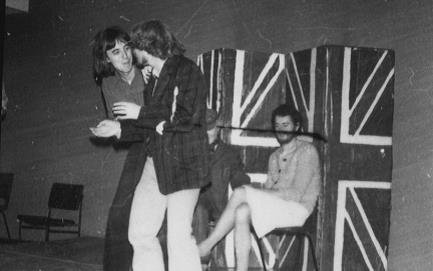
(L-R) Stephen Gee as Straight Brother, Alastair Kerr as Boy, and Edwin Henshaw as Mother
In 1975 a meeting in Crawley called by CHE to introduce an educational kit into local schools was attacked. National Front "heavies" took over the platform with one placard proclaiming "Keep queers out of our school". In order to justify the NF position their parliamentary candidate for Horsham and Crawley described homosexuality as a "disease" and something that would "infect children”. Later the Crawley NF chairman responding to the CHE proposal to set up a group was quoted in the Brighton "Evening Argus" as saying:
"We will do everything in our power to see that his centre does not come into existence“
(12/12/75).
Again in London between 1976 and 1978 there were a number of attacks on gay places and public meetings by local youths and fascist gangs. In 1976 the North London Gay Centre in Finsbury Park and the East London Gay Centre on Redmans Road, Stepney were repeatedly attacked and had everything thrown at them from scaffolding poles to large lumps of concrete. One North London Gay Centre contact who had infiltrated the British Movement told of their modus operandi. They would simply hand out drinks to youths in local pubs as a bribe and get them to come along to attack the centre. The contentious issue of homosexuals living in the neighbourhood made the centres an easy target.
In September 1977 a public meeting at the Conway Hall, Red Lion Square, called by the Paedophile Information Exchange to debate issues around sexual and emotional relationships between adults and children was picketed by hostile forces after a hysterical press campaign against PIE. Allegedly made up of angry housewives and mothers from Leytonstone it soon became clear that the whole thing had been orchestrated by the National Front with union jack badges and banners in evidence. Taking a cue from gutter-press headlines one banner proclaimed: "Human Beings Against Paedo-viles". Organised like a military operation NF thugs fanned out into side streets to stop and question those leaving the building. Anyone suspected of coming from the PIE meeting was kicked and beaten. Others were chased and severely beaten with the police initially reluctant to intervene until things became so bad that they had to.

(L-R) Alastair as Ross McTwitter and Terry Stuart as Father
The Royal Vauxhall Tavern in Lambeth, one of London‘s oldest and best known drag pubs, was attacked on the Saturday night of 27 January 1978 by between sixteen and twenty men wearing National Front union jack badges. They waited until closing time before going "berserk". Everything got smashed up including the optics and one of the last two remaining customers was struck in the face by a heavy water bottle. The men left their calling card by plastering the pub with NF Stickers.
In I977 and 1978 there were a number of assaults against gay buildings and people in Leeds. The Leeds Gay Centre had its windows smashed on several occasions and later a letter threatening further action was sent to a local community newspaper. The National Front claimed responsibility and soon after the Gay Centre had to close because of a serious fire. In June 1978 the Gay Liberation group was attacked once again in the “Fenton Arms" a student pub near the University. Over a dozen young men wearing NF badges entered the premises and assaulted the people drinking there. A young man not connected with the gay group was blinded and a woman was injured.
In 1979 following the closure by police of five gay clubs in Brighton for allegedly infringing the licensing laws and the arrest within a two week period of titty gay people a meeting set up by CHE and Sussex University Gay Society to show the film “Word Is Out” was viciously attacked by the National Front. Eight people were assaulted and two had to be taken to hospital with their injuries. A picket of the "Evening Argus " and a massive phone-in, encouraged by Brighton Gay Activist Alliance, forced a partial retraction of the papers coverage which virtually agreed with the fascist point of view and fomented the attacks. The paper also agreed to publish a reply by local gay groups.
The fascist attitude to women in society was designed to enforce conformity to ‘family values‘ embodied in the ‘cherished feminine role‘ of housewife, mother and homemaker. Viewing the family as the prop of national stability and sounding warnings of the dire consequences accompanying the breakdown of family life the attack against ‘liberal’ values of equality came on several fronts.
The National Front wished to reintroduce the stigma of illegitimacy to children of single-parent families. Sexual activity for them was a matter of procreation and nothing else (at least for women) and unmarried mothers were to carry the full brunt of society's contempt for destabilising family life and by implication disrupting national cohesion.
Contraception and abortion were anathema to fascist thinking. What they adopted was a ‘pro-natalist‘ policy. The economics of parenthood and child welfare schemes for them should be designed to promote the raising of large families rather than ‘family planning‘ race and nation out of existence. ‘Freedom of choice‘ for women was not consistent with national survival and expansion.
Fascist ideology was not beyond delving into ‘primitive mysticism‘ and metaphysical explanations for the role of woman in society as Earth Mother to Man's Sky Father:
“... Man the idealist puts woman in a state of material dependence. But woman the materialist returns the favour by placing man in a state of spiritual dependence“
(SPEARHEAD, January 1973).
It is hardly surprising under such circumstances that lesbians were simply seen as traitors to womanhood because they put their own perverted pleasures in place of producing a family. Apart from execration in the pronouncements of various fascist publications and from individuals within fascist organisations lesbians were physically assaulted and verbally abused in the attacks already mentioned. Women who did not ‘look right‘ in the sense of not conforming to social stereotypes of womanly appearance were assumed to be lesbians and were also attacked. (sources: GAYS AND FASCISM workshop, NUS gay rights conference, Sheffield, 26 October 1974. Morning Star, April 1979? Anti-Fascist Handbook, London GAA, 1979.)

(L-R) Terry Stewart as Father, and Edwin Henshaw as Mother
The most strident religious attacks on homosexuality came from individual evangelists and the Nationwide Festival of Light, an agglomeration of different christian groups brought together for the purpose of bringing about a resurgence of christian values in what was perceived by them as a society disintegrating through the effects of permissiveness and moral decline. This ‘moral rearmament' movement, in which Mary Whitehouse who was later to prosecute Gay News played an important part, was quickly judged by various Gay commentators to be actively promoting a right-wing ideology consistent with the views of fascist groups. Viewed as a kind of moral wing of fascism, intentional or not, the movement had to be vigorously opposed. In one of their earlier leaflets designed to drum up attendance at a NFoL mass rally in Trafalgar Square on 25 September 1971 the message appeals to the desire for a cleaner environment:
"Wouldn't it be a wonderful world if seabirds didn't get oiled up, whales didn't face extinction, water was pure and the air everywhere as good as in the Swiss Alps‘?
The fight to get the seas clean, the land safe and the air pure, is international. The USA had an Earth Day when people demanded that creation should have the right to live - not die. Our country spends the same fortune on the battle against pollution.
Supposing people respected each other as people; that truth, purity, love and family-life weren't just treated as old-hat but encouraged in films, print and television. That sex was for love and caring, not exploitation and selling, not hate and hurting, and that violence was treated as offensive. In other words that we won the battle against MORAL POLLUTION.”
Believing that moral rather than environmental pollution constituted the greater danger to society's health the N'FoL demanded from Government stricter censorship laws to regulate the mass media's output of material judged to ‘offend against public decency‘ or ‘incite to crime and disorder.‘ A parents right to determine the contents of sex education lessons was also stressed thus strengthening the assumed link between sex and violence as the chief moral pollutants to be confronted head on.

(L-R) Terry Stewart as Father, and Edwin Henshaw as Mother
The militancy of the NFoL‘s approach belied the composition of its membership. Middle class respectability seldom expressed itself in such an organised and vociferous way. The outcry against commercial exploitation of sex and violence (perceived as human weaknesses) for profitable gain even allowed for a facade of pseudo-socialist rhetoric. But the sanctity of marriage and the family, and the dangers of divorce and promiscuity, all figured prominently in the NFoL's ideology in an attempt to create a culture of self-discipline and restraint in conformity to christian values. The point was not lost on fascist fellow travellers who made some inroads into the movement.
But the N'FoL did not just blow hot air. As a highly organised lobby group the insistence was upon deeds not just words. The ‘Action Group’ leaflet titled hysterically "EVIL TRIUMPHS WHEN GOOD MEN DO NOTHING (THE PRICE OF FREEDOM IS ETERNAL VIGILANCE)", quoted various public figures, even humanists, on the need for a change in moral attitudes. Apocryphal warnings were given of the greatest danger since 1940 engulfing the nation and extraordinary statements were made such as:
"We are now in the numb state the Germans were in when jews began to disappear - it was "not done" to notice or protest."
Apart from exhortations to lobby Whitehall and local MPs and to work through local political parties and trades unions there was a more sinister touch to NFoL activities. Members were given instructions on how to become police informants against local newsagents selling pornography and how to use the Local Authorities as ‘legal censors‘ to get undesirable films withdrawn from cinemas. ‘Industrial strife‘ was also included as one of the evils to be combated. Citing rises in illegitimacy, divorce, venereal disease and abortion the urgency to act now to reverse the tidal wave of permissiveness was insisted upon. But how successful were they in mobilising support‘?
According to the NFoL action leaflet at the rally in 1971, 4,000 gathered at the inaugural meeting in London, with marches and rallies in Cardiff (3,000), Glasgow (4,000), Manchester (25,000) and many other towns accompanied by ‘hundreds of thousands’ attending the lighting of 300 beacons. In the same leaflet it was stated that a petition for public decency with 1,500,000 signatures was presented to l0 Downing street on April 17, 1973. Even allowing for propagandist exaggeration the mobilisation of the respectable middle class was a feat in itself and the effect gained through reinforcing the need to tum back liberal 'permissiveness‘ helped to create a more reactionary climate of censoriousness by insisting on a return to traditional values. Later, in the 1980s, as the leading light in the National Viewers‘ and Listeners‘ Association, Mary Whitehouse no longer had to lobby hard as part of an extra-parliamentary pressure group. She was invited to share the same platform as Margaret Thatcher. The years of mass rallies and lobbying had paid off with a right-wing government attempting to enforce a return to older ‘Victorian’ moral values. Tightening up discipline and order through repressive government legislation, the promotion of traditional family life against threats from the demand for LGBT+ rights among others and the shackling of trades unions had moved to centre stage in politics.

(L-R) Stephen Gee as Straight Brother, Alistair Kerr as Boy, and Edwin Henshaw as Mother
What was the NFoL’s and NVLA’s official attitude to homosexuality? Anita Bryant’s conviction that God created Adam and Eve not Adam and Steve was no doubt heeded but the ingrained Christian view was to ‘Love the sinner but not the sin’ as though being gay was a polluted part of an individuals life that should be excised through prayer, repentance and abstinence. Engaging in homosexual acts is sinful but with careful shepherding moral turpitude and the decline of society's well-being could be avoided. Nowadays this translates into the obscenity of ‘conversion therapy.’
Psychiatry shifted the locus away from sinfulness, criminality and degeneracy to a sickness that needs to be cured. However cranky or even plausible psychological theories were about the nature of homosexuality they always provided useful justifications for repression. This medical model of sickness rather than a scriptural denunciation of sinfulness or social disapproval through legal means was reached through pseudo-scientfic evaluations of sexuality and an unquestioning acceptance by the psychiatric establishment of the status quo as far as social attitudes to homosexuality were concerned. The emphasis was on either adjusting the patient to their unfortunate condition, thus providing a more ‘integrated’ personality, or attempting a cure for homosexuality through aversion therapy using electric shock treatment, hormone treatment or nausea inducing drugs. Those approaches confirmed the fact that homosexuality was an abnormal deviation from the heterosexual norm and as such was fair game for the ‘readjustment of maladaptive responses to the environment‘ gobbledegook. This kind of justification for psychiatric intervention, used mostly to explain the disintegrated and distressed state of people afflicted by schizophrenia and other ‘psychotic’ disorders was also used to explain the reasons why homosexuality was a suitable case for treatment. In the absence of any positive expressions of support for and pride in being gay many isolated homosexuals turned to the medical profession for help.
The difficulty of growing up gay in a society being endlessly fed bigoted attitudes to anything ‘different’, including homosexuality, often led to gay children unconsciously evolving strategies of avoidance and refusal in avoiding unbearable living situations. By not adopting the aggressive competitiveness and macho attitudes required of other male children their behaviour was seen as ‘odd’ and ‘queer’. Depression and paranoia, as a result of the inability to find positive social confirmation of homosexual feelings, oflen led to familial estrangement and alienation and the consequences of this ‘defiance’ would end in a breakdown in relationships and an inevitable ostracising of the gay child(ren). All of these themes are dealt with in "Out of It" in an attempt to show the interconnectedness of different sources of oppression with a final scene depicting the small but growing influence of the gay liberation movement in challenging that oppression.
-
The opening scene begins with “When we Sound the last all clear” (Vera Lynn - 1941) and depicts Mother and Father steeped in nostalgic memories of the past; a past dominated by the depression, the war and social changes accompanying the immediate post-war period. But this is not simply a warming, rose-tinted view of the past. It is also one marked by bitterness and bewilderment about the state of present society, a familiar song of sadness from the ‘older generation‘ looking at disturbing new features of contemporary life.
For Father, recalling distant memories of his father's comments, the thirties was a time of bread queues, dole queues and idle shiftless men standing around on street corners with the communists to blame for it all. His personal memories were of his mum unable to give him any money for the pictures or the zoo. The war intervened and put an end to the misery by creating the new, heroic ‘Dunkirk’ spirit where everyone pulled together to defend Britain against ‘the hun menace‘ and to fight for freedom. Even those who were unfit for the army joined the Home Guard and his Mum joined the Red Cross. After Dunkirk and the emotional homecoming of his father, looking wasted but cheerful, family bonds were cemented. At the end of the war he recalls union jacks strung between the houses to celebrate Britain's victory and the conviction that much had to be done to make Britain a great nation once again. All went to church that day to pray for the dead.
For Mother the memories were radically different. She remembers being scolded by her mum for playing out on the streets with all the boys. She has little recollection of anything much beyond helping with the washing up and housework. Her secret life consisted of sneaking out of the house to watch the greyhound races in a nearby field and marvel at the men who spent the last of their dole money on the dogs. Dad told her off when she first started wearing make up and mum disapproved of lipstick and mascara. The bright spot for her was the war itself. The screeching of bombs and the destruction of neighbouring homes with fire engines suddenly arriving made the dull housework seem more exciting especially since she was holding the fort for all the others. Bells rang out on the day war ended and she recalls everyone getting drunk including herself.
There are references to ‘real’ dancing like the jitterbug and to swing bands in contrast to the ‘rubbish’ of modem times. When they met and married after the war Father remembers his pleasure when their first child was a boy. His joy was increased unimaginably when the second child was also a boy. The implication is of course that female children are second rate and carry less value in terms of family life.
These opening scenes build up a composite picture of a world in which the moral order is an ‘old fashioned‘ but very much reassuring one of sacrifice in times of crisis. Fortitude in the face of adversity and victory at the end of troubling times act as a powerful message of hope for the resurgence of a greater Britain. Chauvinist flag-waving, christian worship and the sense of everyone pulling together are contrasted with a growing awareness of a world slipping away into fecklessness and ruin. But the picture of a secure and harmonious moral order is an uneven one for Mother.
Mother, as a child, is kept at home in this world but the problem is ‘home’ is not where the heart is for her but is a place of sterility from which she longs to escape. Where men are free to inhabit a public sphere of ‘masculine’ pursuits in which soldiery in defence of the nation is elevated to the highest possible goal Mother, as a growing girl, inhabits a privatised sphere of domestic drudgery lightened only by her secret visits to forbidden pastimes enjoyed only by men. A growing awareness of her sexuality is strictly policed by her parents and in a perverse way the destruction and chaos brought about by bombing slacken her boredom and create a sense of excitement if not meaning in her life. Her ‘heroism’ has nothing to do with saving Britain from enemy invasion or even working in a munitions factory as part of the war effort. It consists of enduring and surviving her allotted role as a household menial. In the home any real status as a human being on an equal basis with men is denied.
Mother and Father stop their reminiscing as the spotlight shifts the focus of attention onto their two sons playing together as children.
The relationship between the two brothers, one straight and the other gay, begins on an equal footing of mutual friendship and support as they go fishing together. But subtle and gradual changes in attitude from the gay brother to suggestions made by his sibling signal the dividing of the ways. The gay brother derides his straight brother's ‘excellent’ mark on his school report for sport as something ‘that doesn‘t count‘. He questions the need to go to the school football match which provokes an angry response:
“Well, it's our school isn‘t it? It's us against the grammar school. We've got to beat them you fool If we don't smash hell out of them, they'll do it to us “
His indifference towards which team wins the game is expressed by a confused and naive supposition that it was only meant to be ’ a game‘. A third boy enters and proceeds to talk about ‘girly wirlies'.
(music: "The Stripper")
The boy’s date with Linda from 3B was a result of winning a bet from ‘the lads‘ that he couldn't get off with her in a month of Sundays. Straight brother greets this conquest with an assurance that he will persuade Rose to go to the pictures with them that evening. Gay brother makes a feeble excuse that he has homework to do which prompts boy 3 to wonder whether or not ‘prof’ likes girls and that people might think he is ‘bent’. Straight brother's angered assertion: "Hey! No brother of mine's queer. Are you bruth?" is greeted by a quiet and unconvincing denial. The spotlight returns to Mother and Father as their memories have shifted in time to the mid-1950s.
The cinema 'riots‘ following a showing of the film "Rock Around the Clock“ act as a focal point in cementing their belief that the country has gone to the dogs. For Father rock n‘ roll is "Damned dangerous music with its jungle rhythms" and is commensurate with a slide towards "permissiveness, blasphemy and pornography“. Mother retreats from her original position of viewing it as all good clean fun by chirping a feeble “and football hooligans and communists" as a sop to his growing anger. For Father the Welfare State is to blame for molly coddling youth out of any sense of responsibility and he blames communist-led, striking trades unions for bankrupting firms and causing unemployment. Homelessness for him is caused by a shortage of housing because the country has been taken up by immigrants. Mother's quiet insistence on a defence of the unemployed and the poor is drowned out by an appeal to the ‘Dunkirk’ spirit to bring back some pride in ‘our country‘. The scene ends with a blackout and chants of ‘ENGLAND! ENGLAND! ENGLAND!‘
The father figure could be seen as a caricature of bigoted attitudes and opinions but given the sense of a lost past of solidarity, growing turbulence of militant trade union activity, and rebellious youth challenging a dull, conformist culture, the opinions expressed were not far underneath the surface of both the respectable middle and working class and resentful ‘lumpen‘ elements who would pick a fight with anyone if the cause or price was right. Fascist ideology could easily be tailored to appeal to all this pent up anger and frustration rooted in anxiety about the future of British (English) society.
-
Played for laughs but also making serious connections between christian zealotry for ‘decency’ and the drive towards censorship and right-wing politics, the first part of this scene depicts a religious meeting. The Chairman of the proceedings begins appropriately with a prayer ending in mock adulation of his invited guest, Mr. Ross McTwitter.
McTwitter wishes to convey to his captive audience of like-minded people some practical ways of dealing with sin not failing to mention the fact that both of his books on the subject are currently on sale: “Whatever happened to Shit?" and "Who does She Think Shit is?" in a slightly displaced reference to Mary Whitehouse's books of a similar title. Using the excuse of a lack of time he resorts to generalisations in a set-piece speech designed to raise the temperature to fever pitch in the best of evangelical orgasmic deliverance. With the ‘British taken out of broadcasting as fast as certain church leaders have taken the Christ out of Christianity’ a shopping list of sinful activities gleaned straight from the christian bible and church teachings inevitably makes its appearance. Against depravity, obscenity, pornography, pre-marital and post-marital sexuality, blasphemy, lechery, gluttony and sodomy and the infiltration of the good and the right by the left he proposes a four letter word (music: "The Stripper“‘). A four letter word that must be adopted by the movement - STOP! STOP! STOP! STOP! In god's name STOP!
He leaves the stage amid muted, polite applause. The scene shifts to a brief encounter between the gay son and a priest in the confessional. Nervously unable to admit at first that he is a homosexual the gay son eventually confesses. The priest is relieved that he has not actually sinned with another man and his response is to quote chapter and verse the biblical prohibitions on homosexuality and the injunction to take a wife and create a family. ‘Man shall not lie with man‘ he is told but god will save him if he prays hard enough. Cold comfort from the confessional as well as militant opposition from the evangelists. Exit both in opposite directions and enter a four-line chorus extolling the redemptive power of Jesus and christianity:
David S: What have these dear people got to comfort their lives - CHRISTIANITY. These people were like this before Christ came into their lives.
(moving into praying position)
Terry (dad): Jesus makes me PURE.
Bill/Steve’): Jesus makes me SURE.
Gay son et al: Jesus gave us a CURE.
(move back into slouching stance)
-
In a similar manner to the religious meeting this scene deals with one on psychiatry and flows into the gay son's meeting with a doctor on his continuing journey from expert to expert accompanied by a guilt-ridden anxiety about his homosexuality. Dr. Fields is presented by the chairman as having a special interest in the problems of the young. He is especially perturbed by the increase in mental and emotional disturbance to the youth of the country. For him the cause can be traced to lack of parental care and control and unprecedented economic growth which has led to sexual license and the youth bloated with an excess of money which they use irresponsibly. He sees certain forms of this psychological upheaval, particularly homosexuality, as a threat to the family and the very fabric of society. After apocalyptic warnings that the family is under attack from without and from within he reiterates the many-times expressed cliche and ‘truism’ that:
"Healthy bodies and healthy minds cannot be maintained without healthy families."
He leaves the stage to the usual applause and is replaced by the gay son and another psychiatrist from whom he seeks an interview. Like the priest yet another ‘expert’ has little to offer except the assurance that homosexual feelings are only a temporary phase and if the problem persists aversion therapy treatment is available to cure the problem. The gay son's anxieties are not relieved and the commercial jingle arrives to propagate a quack cure:
David S: Unhappy‘? Depressed? Why not drink a vein full of freedom or swallow the pill of liberty - try this...
Edwin: Psychiatry helped me FIND.
Ian: Psychiatry made me KIND.
Alistair et al (with eagerness and enthusiasm) Psychiatry destroyed our minds.
(blackout)
-
The lights go up on two characters poised on either side of the stage with leaflets in hand. One represents the NFoL and the other is NF. FATHER and STRAIGHT SON are walking by. STRAIGHT SON receives a leaflet and begins to read:
“The National Front puts Britain first. All WHITE BRITISH workers unite and fight - smash the multi-racial society. Repatriate all immigrants now l Smash communism and its collaborators in the government and unions." Hey! You ought to give one of these to my old dad over there. I think he'd appreciate it.”
STRAIGHT SON’S gives a non-committal reply when invited to vote for the NF at the next election and to attend a political meeting. He quickly follows this with by airing a string of racist prejudices combined with nationalist sentiments and economic self-interest. As the owner of a thriving building firm he balks at the idea of communists organising trades unions and would rather give jobs to ‘our own kind‘ than immigrants. He speaks of their lack of intelligence to do building work and their illiteracy and inability to speak the ‘Queen's English‘ which prompts him to keep the fascist leaflet to ‘think it over.‘ They leave the stage in opposite directions to be replaced by two NF characters who stand and glare at the audience menacingly while slapping heavy billy clubs into the palms of their hands. During this activity a blaring ‘Martin Webster‘ speech is heard on tape creating a similar ambiance to the NFoL and Psychiatry meetings with its heightened emotional appeal. The fascist message is one of anger and resentment at the impotence of a spineless government. The failure to stop escalating unemployment and to stop wages from becoming worthless is put down to an unspecified conspiracy. There are no jobs for British workers because the countries resources are being sucked dry by a vast influx of immigrant labour encouraged by international jewish capitalists. The fascist message is that they know what the British people want: the need for a firm hand through strong government to reverse the lside towards decadence and ruin.
(music: “The Stripper"?) The ‘spineless, degenerate, effeminate poseurs’ are to be replaced by ‘dedicated’ people and emphasis is to be placed on a youth that is strong and manly not weak and feeble. The final rousing spurt of rhetoric extols the virtues of the National Front:
“...the only party which has the courage to stand up and say we're proud to be British, proud to be white - WE WANT OUR COUNTRY BACK! WE WANT THE BLACKS OUT OF BRITAIN!”
The scene shifts to the final moment - the fascist commercial break:
Narrator (David) What has this man got that the others lack - FASCISM.
Stephen: Fascism makes me GREAT.
Alastair: Fascism makes me STRAIGHT.
All Together: (correct?) Fascism makes us HATE.
-
ALL THE FAMILY GATHERED AROUND FOR EVENING MEAL.
Father begins to grumble about inflation eating up his wages. He is convinced he will have to sell his car and use public transport which isn't much cheaper. In his opinion the government is populated by a bunch of incompetent idiots. Mother plays mother-without-opinions and offers him some tea which prompts him to enquire after his sons‘ achievements.
Straight son proudly proclaims his acquisition of a new building contract but Gay son resentfully announces the fact that he has been sacked. Astonished at his inability to hold down a job Father points to Straight son as a model of stability and endurance. Straight son has an announcement to make:
‘By the way, dad. You know that I've been dating Joan Royal for some time now. Well, we've decided to get married.‘
This acts as a springboard for all-round congratulations. Father is pleased about the good match to the daughter of a self-made man who built his engineering firm right from scratch. Mother is hopelessly taken aback and expresses surprise twice:
"Oh son - you should have told us."
Breaking all traditions Straight son offers Gay son the honour of being best man at the wedding which is greeted by him with a stony silence. Mother tries to persuade him that it will be a great honour but he must bring a girl to dance with at the celebration meal and dance. Surely, Father enquires, he has a girl at the age of fifteen? He has not! Mother springs maternally to his defence:
"The lad doesn't like that kind of thing. Leave him alone - he doesn't like all that wine, women and song."
But Father is adamant. He is to come with a partner. In a final exasperated outburst Gay son refuses:
"The whole things a farce - keeping up with the Jones's, big flash wedding - I get bored. I feel out of it."
Straight son is blasted into a fury of indignation:
"Out of it! So bloody superior, you are. Tell you what. I'll be best man and you can get married to that friend of yours I found you having a drink with in that dive the other day - right nancy boy he was. Why was you so embarrassed when I came in then‘? You know what I think‘? I know why you don't want to come to my wedding with a girl. You aren't interested in girls are you‘? Homosexual - that's the word for you isn't it?"
Mother is shocked to hear such a word used in the house but Gay son comes clean and admits that he is a homosexual. Mother, in a mixture of shock and bewildered amusement consoles herself with the comforting thought that:
"You can't be dear. They know about these things. You were examined at birth and you were perfect.“
(FREEZE)
Father will pray in church that this will not come down upon their heads and Mother is worried about the neighbours finding out. Gay son says: "Screw the neighbours" and leaves the household - never wanting to see any of them again.
Father, infuriated, insists that he does not want a pervert in the house. It is against the laws of god. Mother is less condemnatory and cool in her assessment of the situation. She has witnessed the effect and is desperate to search out the cause. Perhaps she had been too overbearing towards him and Father had been too kind? When Gillian Crickneck had fallen ill at school Gay son had replaced her in the school nativity play as a soft-spoken Virgin Mary. She is convinced these things leave their mark!
Straight son has joined the National Front and exhorts Mother and Father to follow his example. After all they stand for all that they believe in but what would they think about him having a queer brother?
The spot lights go out on the family and are turned up on two NF figures at the side of the stage. Once again they stand menacingly and rhythmically slap heavy sticks in their palms:
1st NF We are the guts of the party.
2nd NF We are the commandos of steel.
1st NF We will not laugh so hearty.
2nd NF If Britain is made to kneel.
1st NF We are the bringers of light.
2nd NF We will keep our country white.
1st NF No jews or reds shall walk this land.
2nd NF And blacks will leave in fear.
1st NF We are the commandos of steel.
2nd NF We'll kill the fucking queers.
(pointing sticks at the audience)
1st NF Remember. It's not what homosexuals say, it's what they do to your kids.
2nd NF So you'd better watch out! We'll be around.
(both exit to off-stage shouts of “Queers out! Queers out!)

(L-R) Terry Stewart as Father, Edwin Henshaw as Mother, Stephen Gee as Straight Brother, and Ian Townson as Gay Brother
This marked the end of the play but it was felt that it was was too bleak and negative with no hint of any kind of fightback against oppression. Two additional scenes were written to complete the play taking into account the small but growing influence of Gay Liberationists. It's a scrappy ending with the GLF characters acting like the Salvation Army meeting gay men in bars and saving their souls from loneliness and isolation. The onetime hostile bars had become marginally more friendly to people wearing gay badges though it is pointed out that this was more about drumming up trade through encouraging "the tourists to come and gawk at the queers" thus throwing in a quick political point for good measure. Two gay liberationists spot a lonely gay men, almost like an endangered species in need of rescue, and their chatter merges with the babble of conversation at the bar as the lights fade out.
The play was staged at several venues but the most memorable one was the Communist Party's second Red Festival held at Ladbroke house, Highbury Grove, on the 22 October 1977. Here several extracts from "Out of It" were performed in front of the Young Communist League among others. They thought that the antifascist aspects of the play were excellent but, according to Bill Thornycroft, they could not handle gay men embracing and kissing!